Sorry to Break It to You, But Your Cat Doesn't Have Nine Lives — Here's What It Actually Has Instead
Let's just rip off the Band-Aid right here in paragraph one: your cat does not have nine lives. Not eight. Not even a backup life tucked away for emergencies like some kind of feline insurance policy. Your cat gets exactly one life, the same as you, your neighbor, and that raccoon that keeps knocking over your trash cans at 2 a.m.
And yet — and this is the genuinely wild part — the myth isn't entirely baseless. Cats have accumulated this legendary reputation for cheating death because, in a very real biological sense, they are surprisingly, almost obnoxiously good at not dying. The nine lives story is basically the ancient world's way of saying, "We cannot explain this animal, so we're going to assign it supernatural properties and move on."
Fair enough, honestly.
Where Did the Nine Lives Thing Even Come From?
The origin of the nine lives myth is, fittingly, a bit of a cat itself — slippery, elusive, and prone to disappearing when you try to pin it down. Most folklore historians point to ancient Egypt, where cats were revered to a degree that makes modern cat people look like lukewarm enthusiasts. Cats were associated with Atum-Ra, a sun god who reportedly took the form of a cat to visit the underworld. Nine, in many ancient cultures, was considered a supremely lucky number — the "trinity of trinities" — so pairing it with an already-mystical animal made a certain poetic sense.
Shakespeare dropped a "nine lives" reference in Romeo and Juliet around 1597, which tells you the idea had already gone mainstream well before the internet existed to make cat content go viral. The phrase popped up in English proverbs throughout the centuries, cementing itself into Western culture with the kind of staying power most of us can only dream about.
Other cultures hedged their bets differently: Spanish and Italian folklore traditionally gave cats seven lives, while some Turkish and Arabic traditions landed on six. Nobody seems to have given cats fewer than six, which is itself a testament to how consistently impressive these animals have been at confounding human expectations across the entire globe.
The Righting Reflex: Nature's Most Dramatic Party Trick
So if cats only have one life, why do they seem to shrug off falls that would send other animals — and definitely most humans — straight to the emergency room? The answer starts with something called the righting reflex, and it is, without exaggeration, one of the cooler things biology has ever produced.
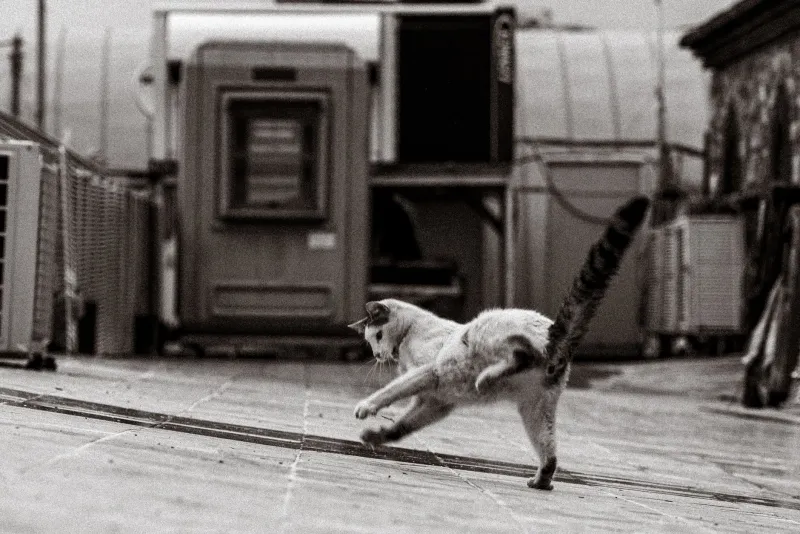
Cats possess a highly specialized vestibular system in their inner ear that detects orientation almost instantaneously. The moment a cat begins to fall, this system kicks in and triggers a rapid, coordinated rotation that rights the body feet-downward — usually within the first half-second of the fall. The whole sequence unfolds so fast it barely registers on video unless you slow it down significantly.
But here's where it gets even more interesting: cats also have a terminal velocity that's considerably lower than most comparably-sized mammals. A falling cat spreads its body out like a tiny, furry flying squirrel, increasing air resistance and slowing the descent. Studies have shown that cats falling from heights above seven stories sometimes sustain fewer injuries than those falling from five or six floors, because they have enough time to fully relax their bodies and distribute the impact across more surface area. Vets in New York City — a town with no shortage of high-rise apartments and adventurous cats — have documented this phenomenon extensively, and it still makes people's brains do a small, confused loop when they first hear it.
Flexible Bones and a Collar Bone That Basically Doesn't Exist
Another piece of the survival puzzle: cats have an almost absurdly flexible skeletal structure. Their collarbones are free-floating — not attached to the rest of the skeleton the way human collarbones are — which means they can compress their bodies through spaces that look physically impossible. This same flexibility helps absorb and distribute the shock of a hard landing in ways that a more rigidly constructed skeleton simply cannot.
Combine that with powerful, well-developed muscles that act as natural shock absorbers, and you've got an animal whose body is essentially pre-engineered for impact survival. Evolution, in this case, did not mess around.
Pain Tolerance and the Stoicism Problem
Here's a slightly less cheerful aspect of feline resilience that veterinarians will tell you is genuinely important to understand: cats are extraordinarily good at hiding injury and illness. This is not a cute quirk. It's a survival mechanism inherited from their wild ancestors, for whom showing weakness was a direct invitation to become someone else's lunch.
This means a cat that has survived something genuinely dangerous may appear completely fine while quietly dealing with internal injuries, fractures, or other serious conditions. The "nine lives" legend has almost certainly been reinforced over centuries by cats who appeared to walk away from disasters unscathed — when in reality, some of them were simply too stoic to let on that anything was wrong. It's the feline equivalent of insisting "I'm fine" while clearly not being fine, except cats have been doing it for thousands of years and they're much better at it than we are.
So What's the Real Magic?
Strip away the mythology and what you're left with is arguably more impressive than any supernatural explanation: a creature that has been shaped by millions of years of evolution into a remarkably efficient survival machine. The righting reflex, the low terminal velocity, the flexible skeleton, the muscular shock-absorption system, the stoic pain response — none of these things are magic. They're biology doing what biology does best, which is finding creative and slightly ridiculous solutions to the problem of staying alive.
Cats didn't earn their legendary reputation by luck. They earned it by being genuinely, measurably, scientifically excellent at surviving things that would sideline most other animals. Ancient Egyptians didn't worship them because they were cute (though, to be fair, they are extremely cute). They worshipped them because cats consistently did things that seemed to defy reasonable explanation.
The nine lives myth, at its core, is just humanity's very understandable attempt to make sense of an animal that has always been, and will almost certainly remain, slightly beyond our ability to fully comprehend.
Your cat has one life. It's just living it with a level of physical competence that makes the rest of us look like we're barely trying.