Flavor Fail: The Hilariously Broken Taste Science That Makes Your Cat the World's Pickiest Eater
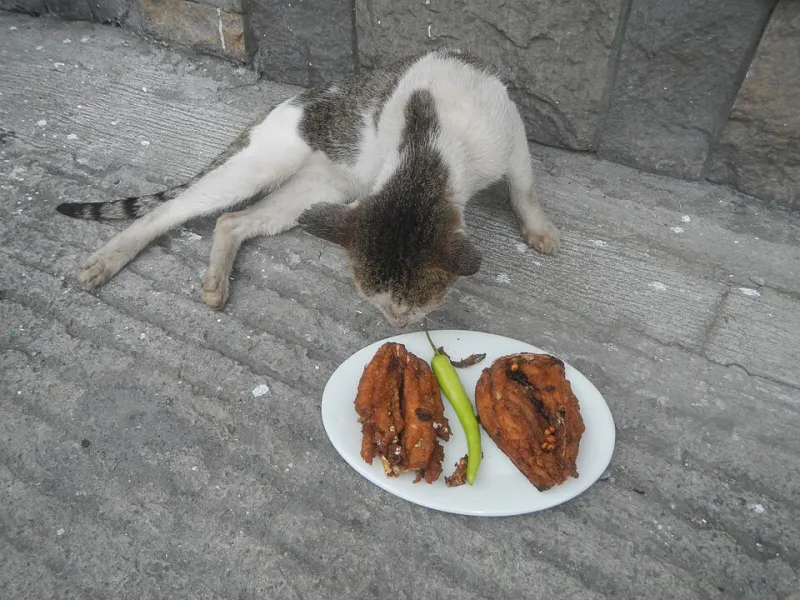
Photo: Judgefloro, CC0, via Wikimedia Commons
You spent twenty minutes deliberating over the premium cat food aisle at Petco. You selected the salmon terrine with garden herbs. You presented it in a clean bowl at the correct temperature. Your cat took one sniff, turned around with the energy of a Michelin-star food critic who just found a hair in their soup, and walked directly to the other side of the room to lick a plastic bag.
Welcome to life with a cat. And welcome to the genuinely strange, scientifically fascinating, and frequently maddening world of feline taste perception — where the rules make almost no sense and your cat's palate is operating on a completely different operating system than yours.
Your Cat Cannot Taste Sweetness. At All.
Let's start with the headline act of feline taste weirdness: cats are functionally sweet-blind. Humans have taste receptors that light up like a Times Square billboard when sugar hits them. Cats? They're missing a critical gene — Tas1r2, if you want to impress people at parties — that codes for the sweet taste receptor. The receptor simply doesn't work. It's broken. Evolution apparently decided that since cats are obligate carnivores who hunt meat for a living, the ability to appreciate a glazed donut was entirely unnecessary.
This means that when your cat sniffs your birthday cake and walks away unimpressed, they're not being dramatic. They literally cannot taste what the fuss is about. The sweetness that makes dessert exciting to you is completely invisible to them. Your cat is, in the most literal sense, taste-blind to an entire flavor category that humans consider one of life's great pleasures.
In a way, this is almost sad. In another way, it explains why your cat has never once tried to steal your Halloween candy, and honestly, that's a relief.
Fewer Receptors, More Opinions
Here's where it gets even more interesting. Humans have approximately 9,000 taste buds. Dogs have around 1,700. Cats? A paltry 470. By the raw numbers, cats are extraordinarily under-equipped in the taste department compared to almost every other creature at the dinner table.
You would think that having fewer taste receptors would make a cat less picky. If you can taste less, surely you'd be more willing to eat whatever's in front of you, right? Wrong. Catastrophically, hilariously wrong. Cats have taken their limited sensory toolkit and somehow used it to develop the most aggressively discerning food opinions in the animal kingdom.
The reason, scientists believe, is that cats compensate heavily with their other senses — particularly smell. A cat's sense of smell is estimated to be 14 times stronger than a human's. So while they can't taste the full spectrum of flavors, they are absolutely drowning in olfactory information before a single bite is taken. That ritual sniffing of the food bowl isn't casual investigation. It's a full chemical analysis. Your cat is running a more thorough quality control check than most commercial food manufacturers.
The Flavors That Actually Work
So if sweet is off the table and overall taste sensitivity is low, what does actually register for a cat? The answer reveals a lot about their evolutionary priorities.
Cats are particularly tuned in to bitter tastes — which makes biological sense as a toxin-detection system. If something tastes bitter, it might be poisonous, and a carnivore roaming the wild needs to know that fast. They're also sensitive to salty and sour notes, though their response to these varies wildly by individual cat (yes, individual cats have taste preferences just like people, which is somehow both charming and exhausting).
The big winner, though, is something that doesn't even have a clean English word for it in casual conversation: the savory, meaty, umami-adjacent quality of amino acids. Cats have taste receptors specifically tuned to detect adenosine triphosphate — ATP — which is a molecule found in living tissue. Basically, their taste buds are wired to detect meat at the cellular level. They're not tasting "chicken flavor." They're tasting the biological signature of actual animal protein. That's either deeply impressive or deeply unsettling, depending on your perspective.
This is also why certain foods trigger something close to obsession in cats. The intense amino acid profile of fish, the rich protein density of chicken liver, the deeply savory quality of a good tuna — these aren't just tasty to your cat, they're essentially triggering the same neural pathways as a successful hunt. That's not enthusiasm. That's instinct.
Why Texture Might Matter More Than Flavor
Here's a plot twist that cat owners often don't consider: for cats, texture may be as important — possibly more important — than flavor. Because their taste sensitivity is limited, the physical experience of eating carries significant weight in whether a food is deemed acceptable or worthy of disdain.
This is why some cats will eat pâté but reject the identical flavor in a chunky format. Why others will tolerate dry kibble but act like wet food is a personal insult. The mouth-feel, the bite resistance, the moisture content — all of these factors feed into a cat's overall assessment of whether a meal is acceptable. It's not just what the food tastes like. It's what it feels like to eat it.
In other words, your cat's food rejection might have nothing to do with flavor at all. They may have loved last Tuesday's dinner and still rejected Thursday's identical purchase because the texture was slightly different, the temperature was two degrees off, or the bowl had a microscopic residue of last week's meal that your nose couldn't detect but theirs absolutely could.
The Finickiness Is a Feature, Not a Bug
It's tempting to look at all of this — the broken sweet receptors, the limited taste buds, the texture obsessions, the smell-based veto system — and conclude that cats are just fundamentally difficult. And sure, that's partially true. But there's an evolutionary logic to the whole setup.
In the wild, a cat that was willing to eat anything regardless of smell, texture, or amino acid profile would be a cat that occasionally ate something rotten, toxic, or nutritionally useless. The pickiness is a survival mechanism. The sniffing is due diligence. The rejection of anything that doesn't pass muster is quality control with genuine stakes.
The problem is that your cat has imported this entire finely tuned wild-animal food evaluation system into an environment where the stakes are... a Fancy Feast variety pack and your feelings.
So the next time your cat stages a dramatic hunger strike over a food they ate happily for six months and now apparently find offensive, remember: they're not being irrational. They're being a highly specialized predator whose sensory apparatus is finely calibrated for survival in an ecosystem that no longer exists, applied to a Tuesday evening in your kitchen.
The least we can do is respect the process — and maybe buy a backup can of the flavor that actually works.