You Spent $300 on a Cat Palace and They Chose a Box: Here's Why Your Cat Is Actually a Genius
Let's set the scene. It's a Tuesday evening. You've spent forty-five minutes on the floor with an Allen wrench, a confusing instruction sheet, and a quiet but growing rage. You've assembled the Ultimate Deluxe Cat Condo — six tiers, two dangling pompoms, one built-in hammock, and enough sisal rope to lasso a small horse. You step back, admire your work, and call your cat over with the kind of excitement usually reserved for lottery wins.
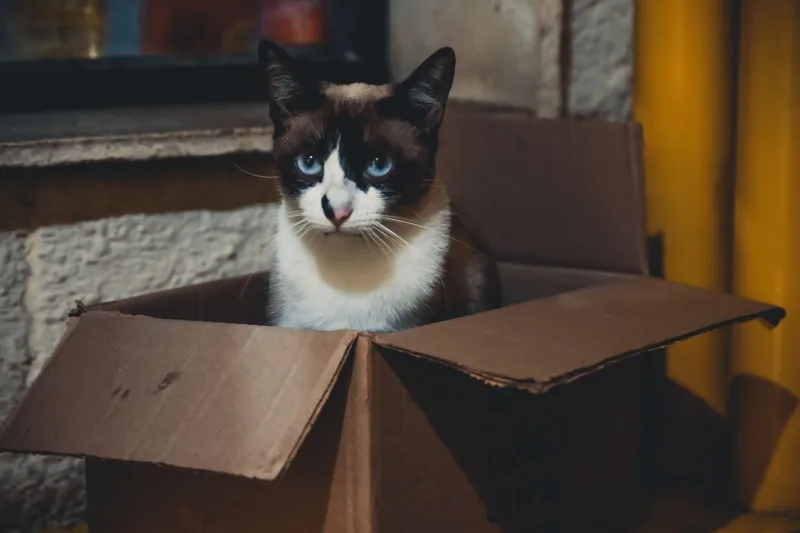
Your cat sniffs the base, blinks slowly, and walks directly into the cardboard shipping box it arrived in.
This is not a personal attack. This is, apparently, just science.
The $300 Question Nobody Warned You About
American pet owners spend an estimated $150 billion annually on their animals, and a significant chunk of that goes toward cat furniture that could generously be described as "aspirational." Cat towers have evolved from simple scratching posts into multi-story architectural statements. Some models come with built-in LED lighting. Others feature faux-fur condos and rope bridges. There is at least one on the market that retails for over $1,000 and looks like it belongs in a minimalist Scandinavian loft.
And yet, ask any veterinarian, animal behaviorist, or exhausted cat owner, and they'll tell you the same thing: the box wins. Every single time. Almost without exception. It's basically the rule.
So what is happening inside that fluffy little head?
Cardboard Is Basically a Five-Star Hotel in Cat Terms
To understand the cardboard box phenomenon, you have to stop thinking like a human and start thinking like a small, highly suspicious predator who also happens to be prey.
Cats are simultaneously hunters and hunted — a duality that shapes almost every behavioral quirk they have. In the wild, a cat needs two things from a resting space: concealment and a clear sightline to the exit. A cardboard box, it turns out, delivers both with remarkable efficiency. The enclosed walls create a sense of security. The single opening provides a controllable vantage point. Your cat isn't being ungrateful — they're being tactically brilliant.
Researchers at the University of Utrecht actually studied this in a clinical setting, finding that shelter boxes significantly reduced stress indicators in cats adjusting to new environments. Cortisol levels dropped. Hiding behaviors decreased faster. The cats with boxes adapted more quickly than those without. The box, in other words, is not a joke. It is a legitimate psychological tool.
Why Your Cat Tower Might Actually Be Working Against Itself
Here's where things get a little awkward for the cat furniture industry. Many elaborate cat towers — despite their best intentions — violate some pretty fundamental principles of feline comfort.
First, there's the smell problem. A brand-new cat tower reeks of factory chemicals, foreign materials, and zero familiar scents. To your cat's extraordinarily sensitive nose, that thing might as well be a stranger's apartment. The cardboard box, on the other hand, smells like your house, your cat, and possibly some packing peanuts — all deeply familiar, all deeply reassuring.
Then there's the stability issue. Many budget and mid-range cat towers wobble. Cats notice this immediately. A structure that shifts underfoot triggers an instinctive alarm — if you can't trust the ground beneath you, you can't trust the space. A cardboard box sits flat, solid, and predictably still on your living room floor. It doesn't wobble. It doesn't creak. It simply exists, reliably, like a good friend.
Finally, consider the exposure factor. Those wide-open platforms near the top of a cat tower? Aesthetically dramatic, sure. But a cat sitting up there is visible from every angle, which is a compromise their prey-animal brain finds genuinely stressful. The enclosed bottom cubby of a cat tower almost always gets more use than the penthouse perch — and that's basically just... a box.
The Texture Conspiracy
Cardboard also has a physical appeal that engineered materials struggle to replicate. The slightly rough surface is satisfying for kneading paws. It's cool in warm weather and retains just enough body heat in cooler temperatures to make it cozy. It compresses slightly under weight, creating a custom-molded fit that no pre-manufactured foam insert can match.
Cats also genuinely enjoy destroying cardboard — scratching at the edges, tearing small pieces, rearranging the interior to their exact specifications. It's interactive. It's customizable. In a very real sense, a cardboard box is DIY cat furniture, and your cat is the architect.
Your $300 tower, meanwhile, came pre-built. Nobody asked the cat.
How to Actually Win the Cat Furniture Game
Here's the good news: you don't have to abandon the cat tower entirely, and you definitely don't have to start hoarding Amazon boxes like some kind of cardboard sommelier. There are legitimate ways to make expensive cat furniture more appealing, and they're all rooted in the same behavioral principles that make the box so irresistible.
Break it in before you introduce it. Leave the cat tower in a common area for a few days before your cat is expected to use it. Let your scent and your cat's scent gradually transfer to the surfaces. Rub a worn t-shirt along the platforms. Place your cat's existing bedding on one of the tiers.
Prioritize enclosed spaces over open platforms. When shopping for cat furniture, look for condos, cubbies, and tunnels over exposed perches. The more a space mimics the enclosed security of a box, the more likely your cat is to actually use it.
Location is everything. A cat tower shoved in a corner of the guest bedroom is furniture your cat will never see. Place it near a window, in a room where the family spends time, or along a wall your cat already frequents. Cats want to observe the action, not be exiled from it.
Don't throw away the box immediately. Yes, it looks ridiculous in your living room. Leave it anyway. Use it as a transitional object — let your cat spend time in the box near the tower, then gradually move the box closer, eventually placing familiar bedding on the tower itself. Slow transitions work better than dramatic reveals.
The Humbling Takeaway
At the end of the day, your cat's preference for a cardboard box over a luxury condo isn't a commentary on your taste, your parenting, or your relationship. It's a masterclass in evolutionary pragmatism. Your cat has spent thousands of years refining exactly what safety, comfort, and control feel like — and a slightly damp rectangle of recycled paper happens to nail the brief.
The box is free. The box is perfect. The box does not require an Allen wrench.
Maybe the cat was right all along.