Southpaw Season: How to Test Whether Your Cat Is Left-Pawed, and What It Might Actually Tell You
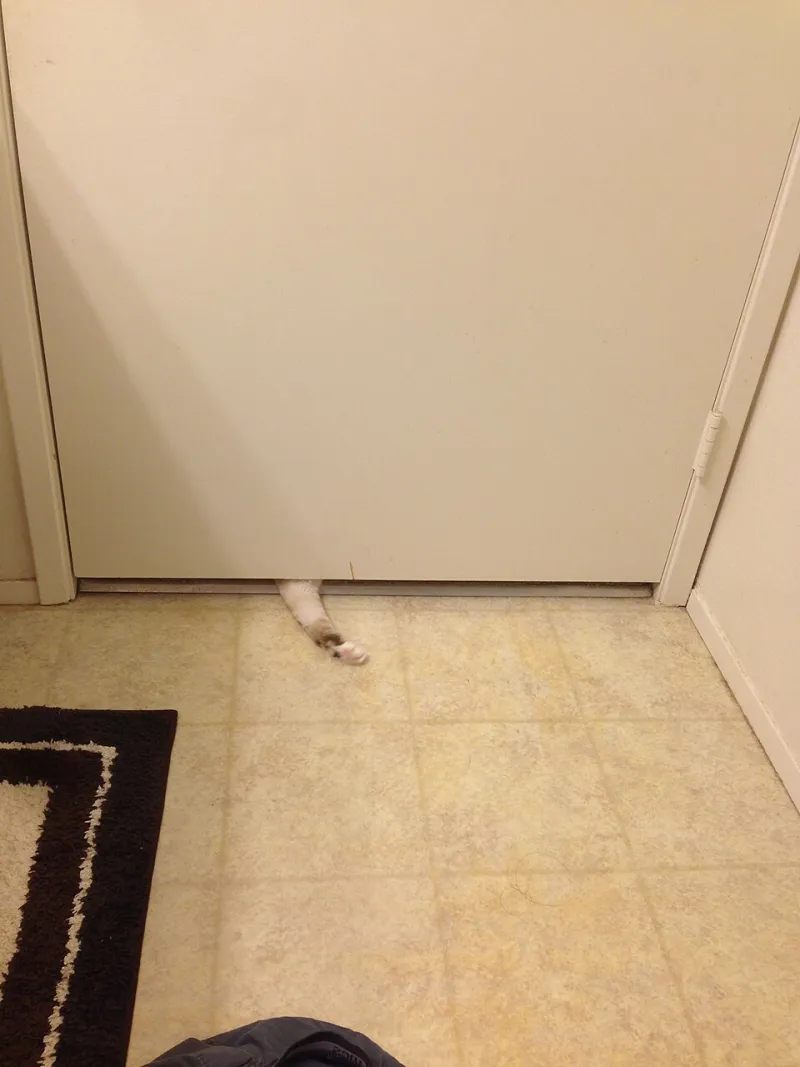
Photo: FASTILY, CC BY-SA 4.0, via Wikimedia Commons
Your Cat Has a Favorite Hand. Probably.
Watch a cat bat a toy under the sofa and you will notice something quietly odd: it almost always uses the same paw. Not whichever limb happens to be closer. Not a random flail. The same one, over and over, like a bowler with a lucky ball.
We tend to file cats under 'liquid' and 'no bones' and 'clearly has no idea what its limbs are doing,' so the idea that they have a preferred side feels faintly absurd. But paw preference is one of the more charming corners of feline research, and it is also one of the messiest. Here is what the science actually supports, what it merely suggests, and how to run your own extremely unscientific experiment before dinner.
The Science Is Young, Small, and Slightly Contradictory
Paw preference — technically 'lateralized paw use' — has been studied in cats for a few decades, and the honest summary is this: individual cats usually have a side, populations are less consistent, and sample sizes are frequently in the dozens.
Some studies have found a mild population-level bias. Others have found none at all. A few have reported that female cats lean one way and males lean the other, echoing a pattern documented in dogs, but that result has not held up cleanly across every sample. When a finding only appears in some studies with forty-odd cats, it is a clue, not a commandment.
The most reliable takeaway is boring and true: most cats, tested repeatedly, will show a consistent preference for one paw. A meaningful minority show no preference at all and are technically 'ambilateral' — a wonderful word that means your cat is equally useless with both feet.
Why Brains Bother Splitting the Work
Lateralization — the tendency for one side of the brain to specialize — is efficient. Put a job in one hemisphere and it gets faster with repetition, the way a kitchen works better when one person always makes the coffee.
In cats, the left hemisphere controls the right side of the body and vice versa. Some researchers have floated the idea that right-hemisphere-dominant animals — the left-pawed crowd — tend to be more reactive to threats, because the right hemisphere is more heavily involved in processing fear and novelty. Studies in dogs support a version of this. In cats, the evidence is intriguing but thin. If your left-pawed cat is a nervous wreck, that is correlation doing its usual misleading dance, not destiny.
The Ten-Minute Test: A Clear Glass and a Pile of Treats
You do not need a lab coat. You need a clear glass, a small, high-value treat, and roughly zero dignity about crawling around on the kitchen floor.
- Set up. Put a clear glass upside down on a hard floor. Slide a treat underneath so your cat can see and smell it but cannot simply grab it with its mouth.
- Let the cat investigate. No prompting. No helpful pointing. Just wait.
- Record the first paw that reaches under the glass. Write it down. Left or right.
- Reset and repeat. Ten to twenty trials, spread across a few days. Cats get bored, and a bored cat will use whatever paw gets the job done fastest, which corrupts your data and your self-respect.
- Score it. Roughly 70 percent or more to one side is a solid preference. Fifty-five to seventy is a lean. Around fifty-fifty means your cat is ambilateral and possibly smug about it.
A few housekeeping notes: do this when the house is quiet, do not do it right after a meal, and do not film it unless you are prepared to watch yourself whisper 'come on, use the other one' at a cat who is openly ignoring you.
Sneaky Secondary Tests
If the glass method fails — and it will fail for some cats, who will simply sit there and stare at you until you fix the problem — try these instead:
- The staircase. Which paw lands first when your cat walks down the stairs?
- The hanging toy. Dangle a wand toy slightly out of reach and note which paw swipes first.
- The burying ritual. After using the litter box, which paw does the covering? Many cats are dramatically consistent about this, and it is the easiest one to observe without props.
Run each one several times. One data point is a coincidence. Twelve is a pattern.
The Genuinely Useful Part: Watch for Changes
The most practical application of all this has nothing to do with personality quizzes. It has to do with pain.
A cat who has always been strongly right-pawed and suddenly starts favoring the left may be protecting an injured or arthritic limb. Cats hide discomfort with the kind of commitment most of us reserve for hiding a bad haircut, so a shift in paw use can be one of the few visible clues that something hurts. Same goes for a cat who stops burying in the litter box, or who now reaches for a toy with obvious hesitation.
If the change is sudden, or comes with limping, reluctance to jump, or a new grumpiness about being touched on a leg, that is a vet conversation. Not an emergency in most cases, but not nothing either.
What Paw Preference Cannot Tell You
It cannot tell you whether your cat is 'left-brained' in the pop-psychology sense, because that framing is nonsense for humans and even worse for cats.
It cannot predict whether your cat will be friendly, shy, aggressive, or a thief. Personality in cats is a sprawling mess of genetics, early socialization, environment, and whatever mood the barometric pressure has decided to inflict.
And it absolutely cannot be used to pick a kitten. Do not go to a shelter with a paw-preference chart and a dream. You will come home with the cat that sat on your foot, like everyone else.
The Verdict
Your cat has a side. It is a small, real, quietly delightful fact about a creature that otherwise seems to be composed entirely of liquid and opinions. Run the test, write down your numbers, and then file the whole thing under 'things I know about my cat that nobody else will ever care about.'
Which, honestly, is the entire foundation of cat ownership.